



Concrete research: ensuring reproducibility with KNIELE KKM-L and KKM-RT laboratory mixers (in collaboration with BSC-Béton Stone Consulting)
- 24 March 2026
- Posted by: Emelyne CHEVALIER--SEURE
- Categories: Concrete industry, Guide
In an R&D context, the difference between a ‘promising’ formulation and one that is ‘ready for industrial production’ often hinges on two factors: the homogeneity and reproducibility of small-scale mixing. KNIELE’s KKM-L and KKM-RT laboratory mixers are designed to deliver homogeneous and reproducible mixes for concrete, mortar, construction materials and complex mixtures.
Why is laboratory mixing so crucial in the development of formulations?
When R&D teams work on self-compacting concrete, special concrete or ultra-high-performance concrete, sensitivity to addition sequences, speeds, tools and mixing times increases significantly.
The KKM-L laboratory mixer is essential for developing homogeneous and reproducible mixtures for formulation testing.
Generally, two requirements often coexist in the concrete industry:
- to produce reliable samples (mechanical testing, durability, appearance, etc.);
- to understand the behaviour of fresh concrete (workability, stability, rheology[1] ).
This is precisely the dividing line between the KKM-L (test production) and the KKM-RT (production + advanced measurements focused on rheology/fresh concrete testing).
KKM-L: a laboratory mixer designed for homogeneity, flexibility and transfer to production
Target applications (formulation + complex materials)
KKM-L mixer is suitable for special concretes, self-compacting concretes, ultra-high-performance concretes, dry mixes and suspensions.
Technical specifications
The KKM-L laboratory mixer is designed for smooth and efficient mixing. Its recognised advantage is its compact design and ergonomic features For laboratories: easy cleaning and simplified maintenance, plus durable materials for long-lasting performance.
The mixing principle common to the KKM series is high mixing quality, simple cleaning and the transfer of laboratory tests to production mixers on an ‘almost full-scale’ basis.
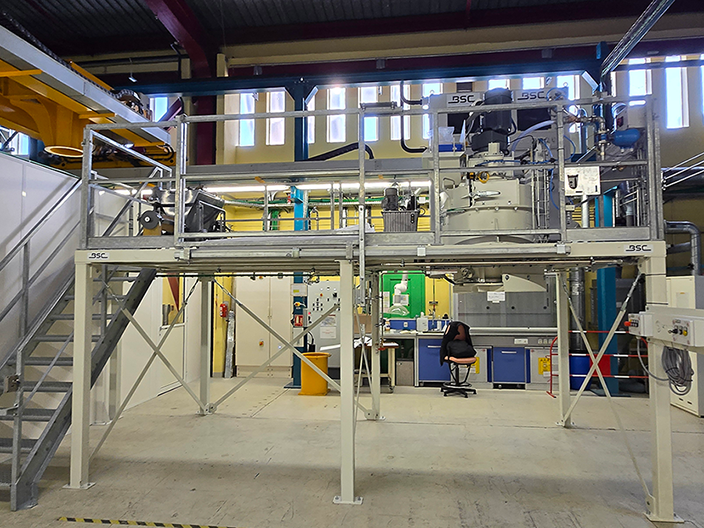
Mobility, speeds, tooling
The KKM-L laboratory mixer can be used either as a portable or stationary unit and can be adapted for high-speed operation using various mixing and drive attachments.
Capacities: standard models and volumes
| Range | Dry mix | Wet mix |
| KKM 30/40 | 3 L to 40 L | 3 L to 30 L |
| KKM 100/150 | 10 L to150 L | 10 L to 130 L |
| KKM 250/375 | 37 L to 375 L | 37 L to 250 L |
Operational readout: these ranges facilitate the transition from a ‘micro-formulation’ protocol to larger batches without changing the mixing logic, which KNIELE presents as an advantage in terms of scalability to production scale.
KKM-RT: when mixing also becomes a testing station (rheology/fresh concrete testing)
Applications and materials
The KKM-RT mixer is suitable for dry and wet mixing, dry mortar, lightweight concrete, mineral concrete, dry chemical mixtures, refractory concrete, liquid adhesives, and animal feed.
Technical specifications listed
The KKM-RT factsheet highlights, amongst other things:
- stainless steel construction,
- output of up to 15 litres,
- quick draining and cleaning,
- determination of rheological properties,
- quick tool change,
- dosing of dry or liquid materials,
- humidity sensor.
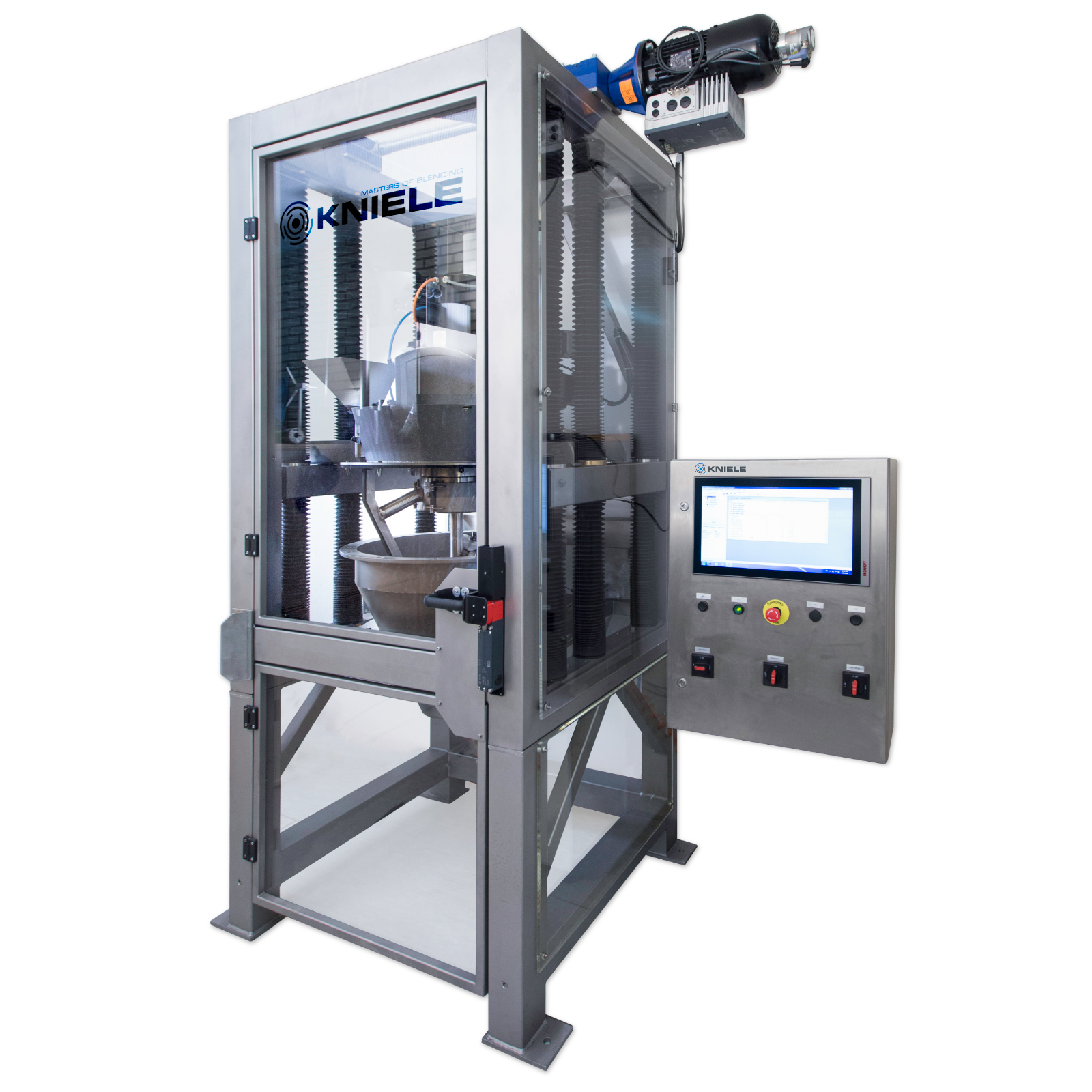
The KKM-RT laboratory mixer is regarded as a laboratory system incorporating rheological and tribometric measurement techniques.
Focus on ‘fresh concrete’
The KKM-RT laboratory mixer is ideal for fresh concrete testing:
- spread measurement,
- setting time measurement directly in the vessel,
- VdZ funnel (V-funnel),
- LCPC box,
- recording of measurements in the software.
With regard to the V-funnel, civil engineering resources refer to the EN 12350-9 standard and the principle of measuring the flow time of self-compacting concrete.
Methodological point: the added value of the KKM-RT lies less in ‘mixing harder’ than in ‘mixing & measuring’, in order to objectively identify deviations in formulation and protocol. This approach corresponds to the rheological measurement of the RT laboratory mixer.
The role of BSC-Béton Stone Consulting in this approach
Our role is to identify your needs and recommend a model that meets your requirements. Our technical sales team supports your laboratory staff and R&D departments seeking to ensure the reliability of their formulation tests through a pragmatic and quantifiable approach. With this in mind, we offer the KKM-RT laboratory mixer as a comprehensive solution combining intensive mixing with rheological measurement, enabling precise characterisation of the material’s behaviour in its fresh state and ensuring the reliability and reproducibility of protocols.
Depending on the configuration chosen, the system can incorporate a humidity sensor and a dosing unit for dry and liquid ingredients, which facilitates control over feeding sequences, traceability of parameters and objective comparison between formulations.
KKM-L or KKM-RT laboratory mixer: decision matrix
Opt for the KKM-L laboratory mixer if the main objective is…
- production of test specimens and the repeatability of test batches;
- volume flexibility (up to 375 L for dry mixing according to the table);
- a compact, mobile/stationary unit that is easy to clean.
Choose the KKM-RT laboratory mixer if the main objective is…
- characterising fresh material using a ‘mix & measure’ approach (rheology);
- small batches (up to 15 L as indicated on the data sheet) combined with metrology (probe, dosing, recording).
[1] rheology, n., phys., eng. Science; the study of the phenomena that govern the flow and deformation of matter (plasticity, viscosity, elasticity) (according to Adr.-Legr. 1981). Rheology is the study of the flow of natural bodies. In fact, it has a broader meaning and also encompasses the study of the deformation of matter, even when this is not accompanied by continuous flow (Encyclop. Sc. Techn. t. 91973, p. 539)., CNRTL, ‘Rheology’, https://www.cnrtl.fr/definition/rh%C3%A9ologie, accessed 10/03/2026
FAQ – KNIELE KKM-L and KKM-RT laboratory mixers
Is KKM-L suitable for self-compacting concrete (SCC) and ultra-high-performance concrete (UHPC) mixes?
Yes. Self-compacting concrete and ultra-high-performance concrete are among the applications for which the KKM-L laboratory mixer is designed.
What capacities do the KKM-L laboratory mixer models offer?
Depending on the model of the KKM-L laboratory mixer, capacities range up to 375 litres for dry mixing (KKM 250/375) and up to 250 litres for wet mixing (KKM 250/375), with intermediate models (KKM 30/40 and KKM 100/150).
What is the key difference between the KKM-L and KKM-RT laboratory mixers in terms of R&D applications?
The KKM-L laboratory mixer is designed to deliver high-quality mixing, even with small batches, with a view to scaling up test results to production scale.
The KKM-RT laboratory mixer is part of a ‘mixing and measurement’ approach, incorporating rheological and tribometric measurement techniques.
Does the KKM-RT laboratory mixer include dosing and moisture measurement functions?
Yes. The KKM-RT 15/22.5 laboratory mixer is equipped with a moisture sensor and a dosing unit for adding liquid and dry ingredients.
What is the purpose of the V-funnel test in BAP?
Standard NF EN 12350-9 specifies a method for determining the V-funnel slump of self-compacting concrete, with a specified limit of use where the maximum aggregate size exceeds 22.4 mm.
Is a ‘laboratory/pilot’ integration still feasible beyond a standalone system?
Yes. We can provide bespoke equipment integration and set up a laboratory or pilot plant on request.