



POLARMOIST™: what the CERIB characterisation reveals
- 10 February 2026
- Posted by: Emelyne CHEVALIER--SEURE
- Category: Concrete industry
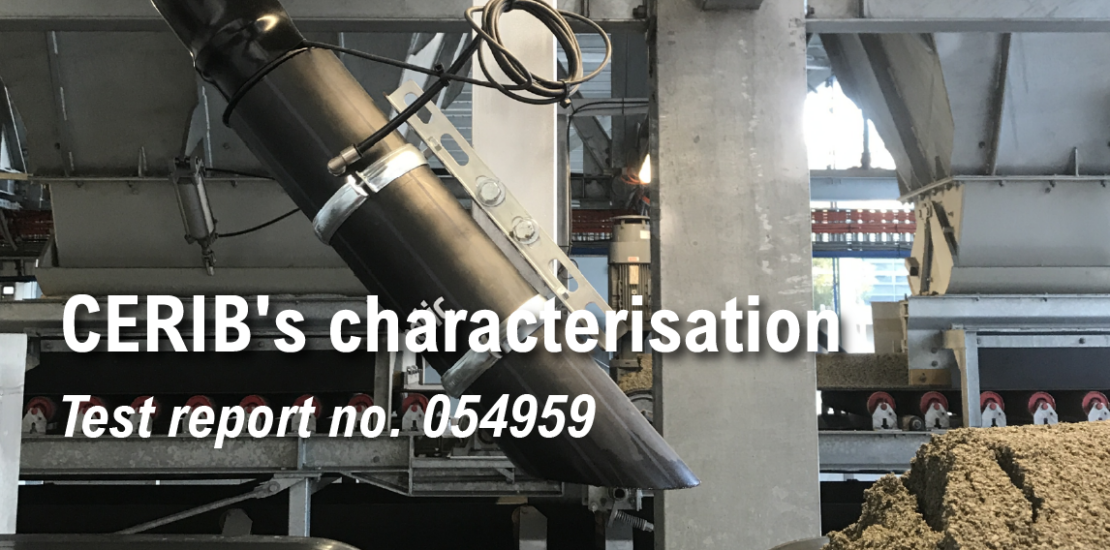
When a moisture measurement solution is intended for integration into production, the question of metrological reliability becomes central: accuracy, repeatability, sensitivity to real conditions (distance, angle, light, temperature). In this context, a series of tests was carried out at CERIB to evaluate the performance of the POLARMOIST™ infrared (IR) sensor and compare its measurements with ‘real’ reference measurements, in order to objectively assess the margins of error and influencing factors.
Context: samples, method and measurement framework
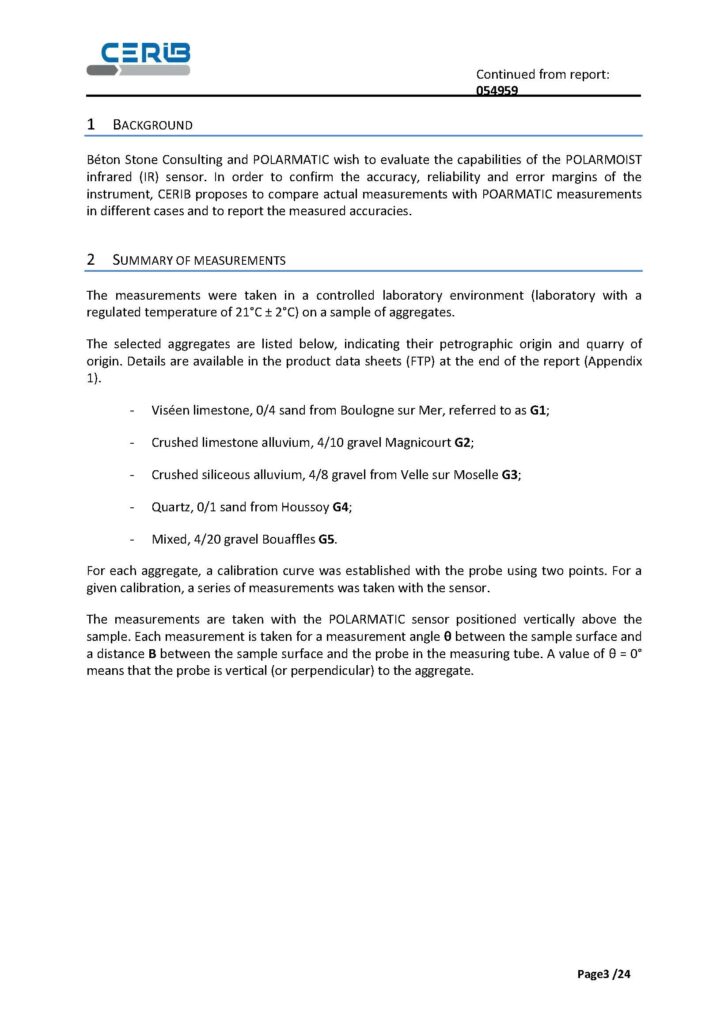
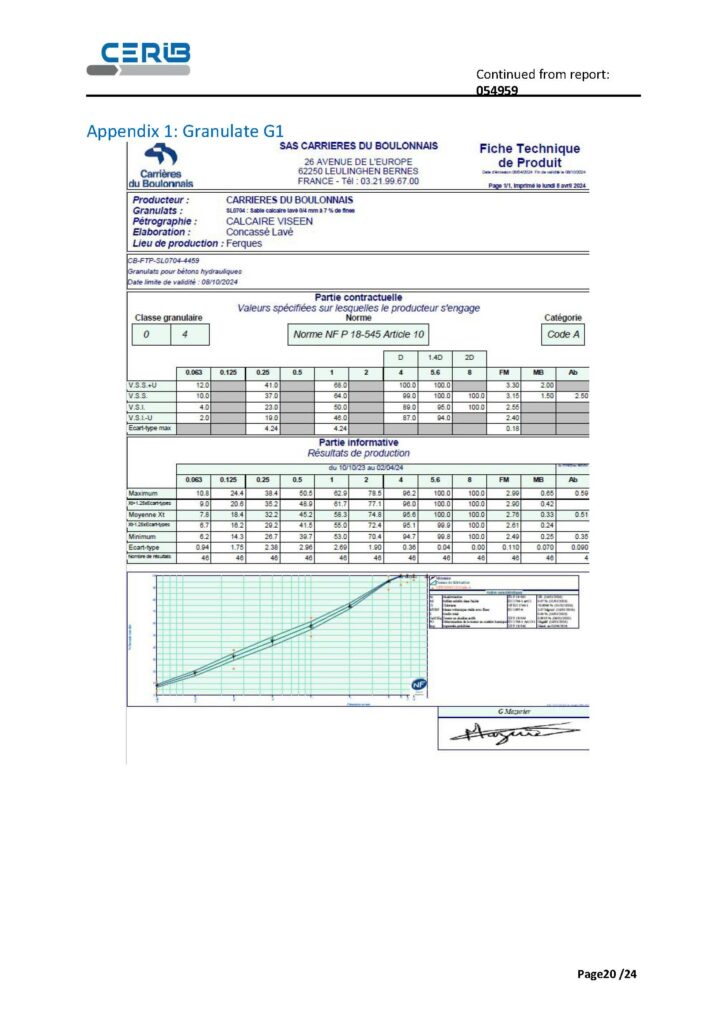
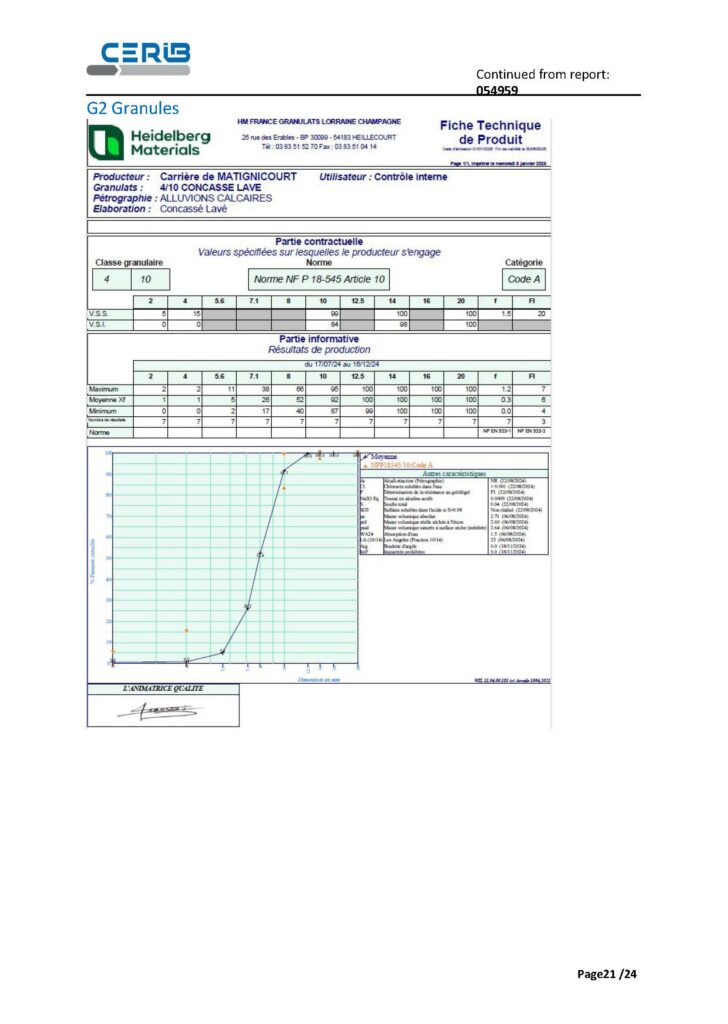
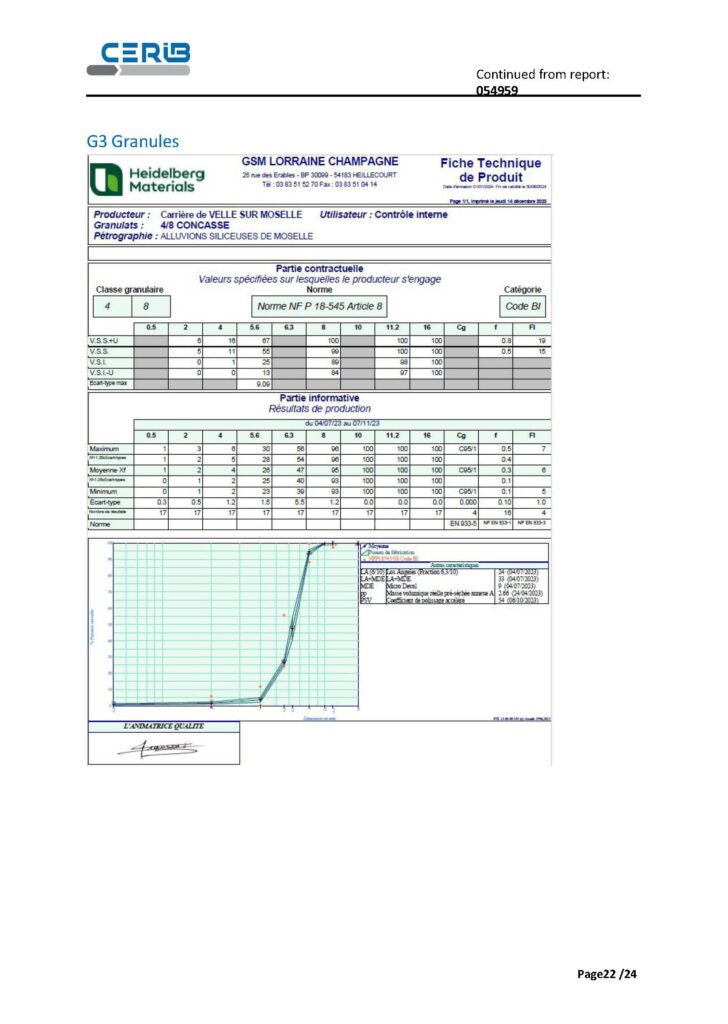
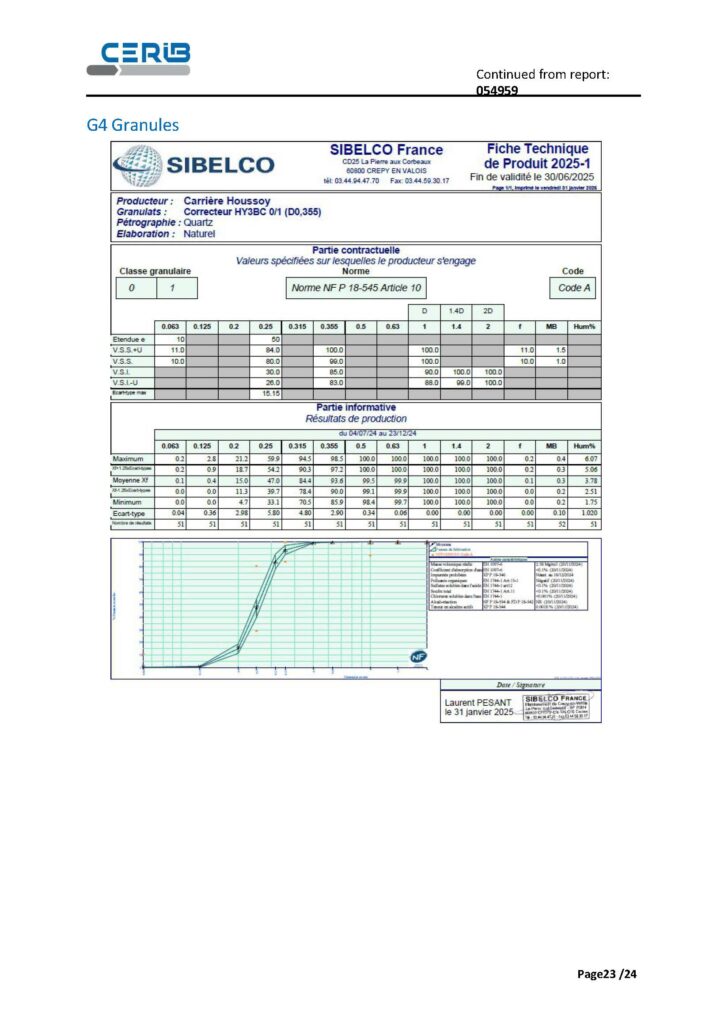
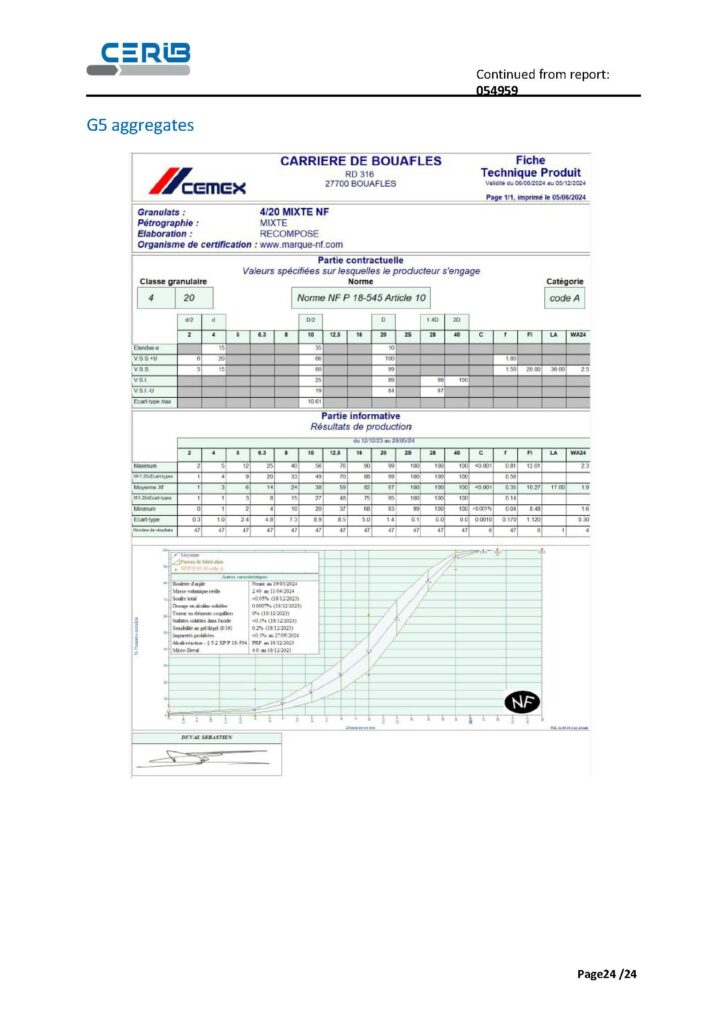
Campaign is being conducted in a climate-controlled laboratory (21°C ± 2°C), on a sample of five aggregates of different origins and types (G1 to G5): limestone, alluvial, siliceous, quartz and mixed.
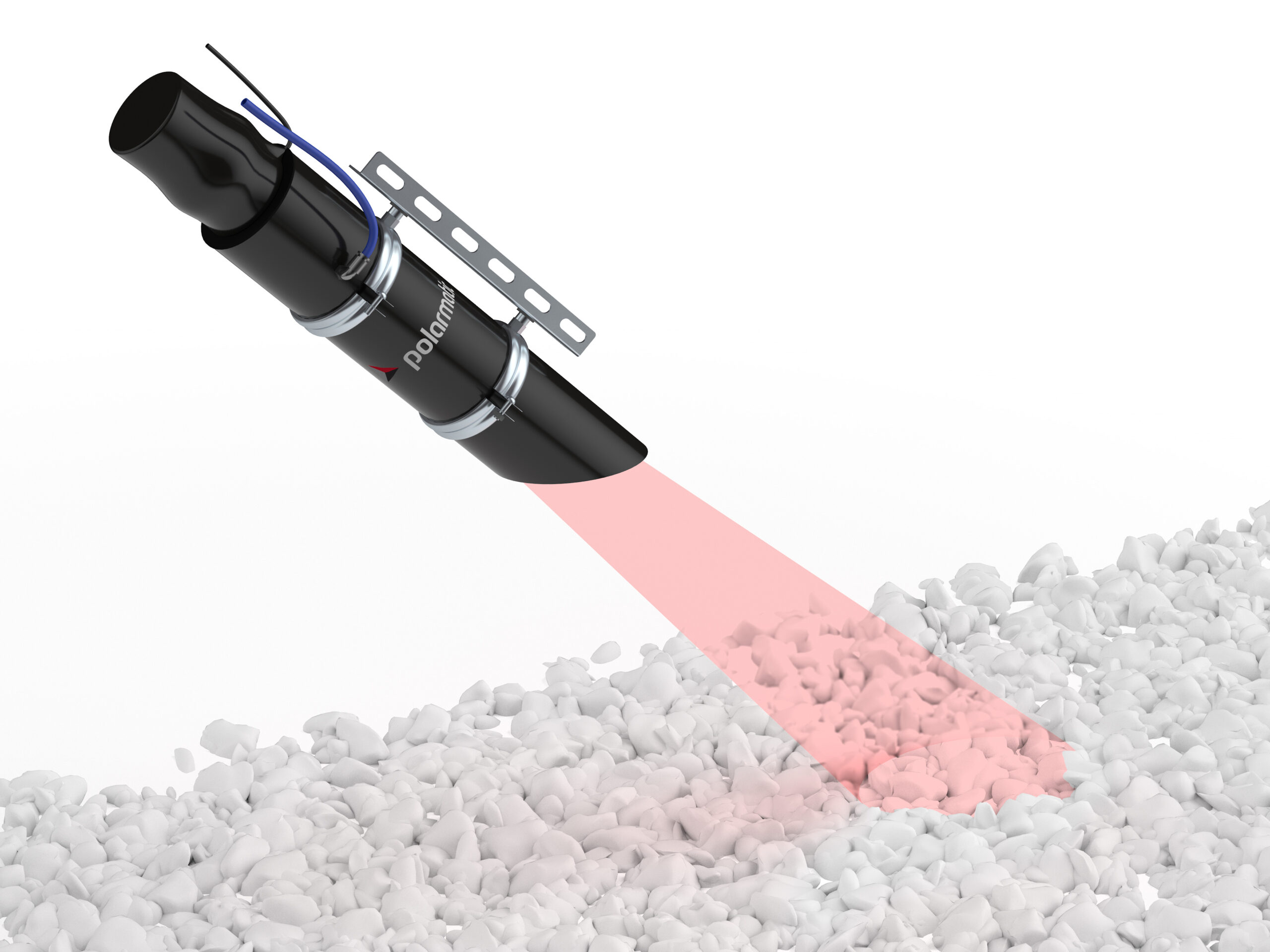
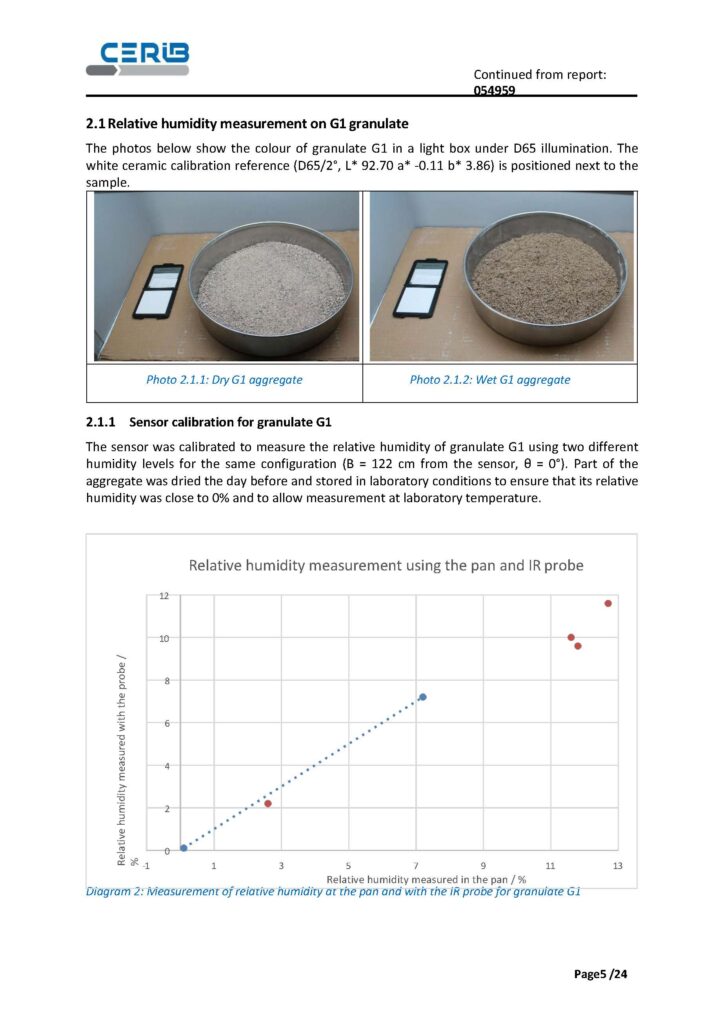
Approach is based on a simple and operational principle: a calibration curve established from two points for each aggregate, followed by a series of measurements taken with the sensor in the defined configuration.
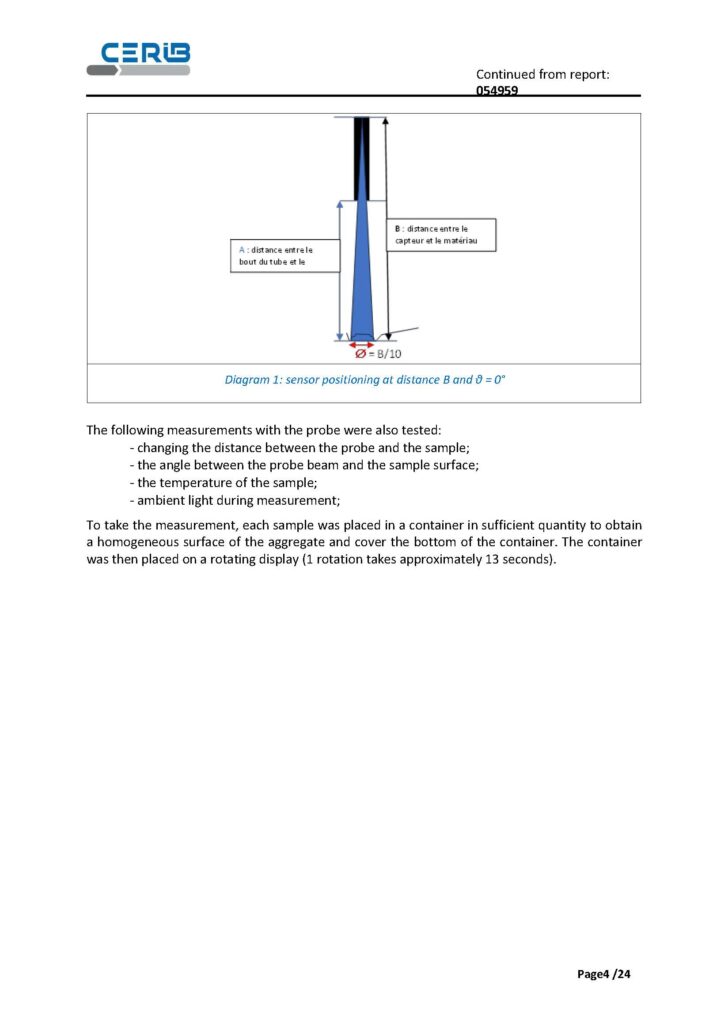
Sensor is positioned above the sample, with two structural geometric parameters:
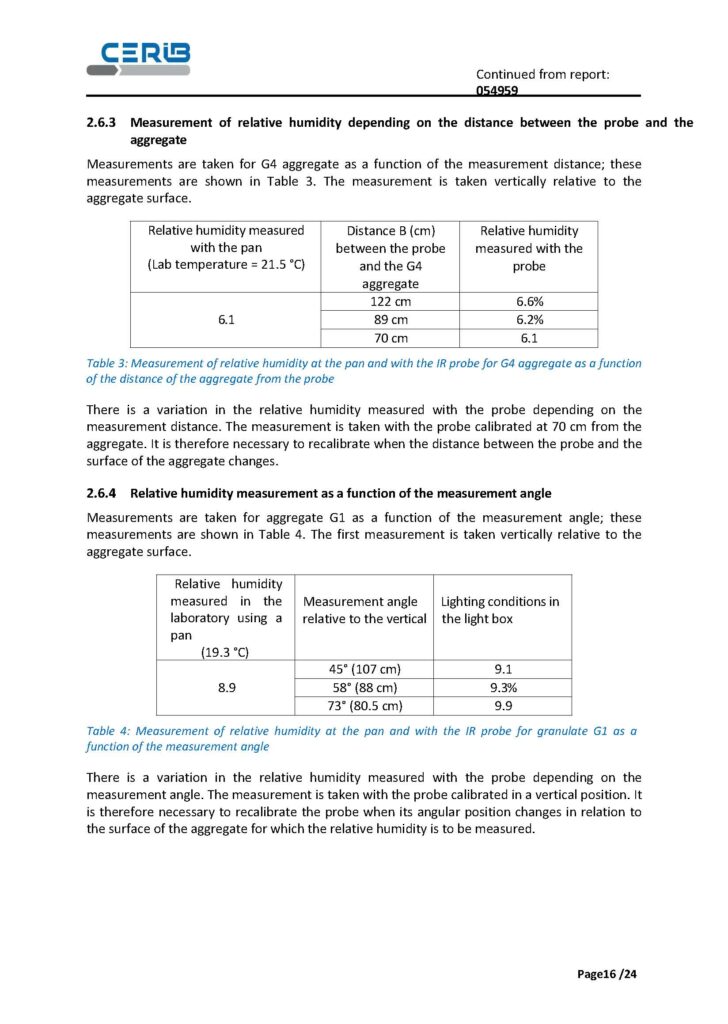
- B : sensor-surface distance,
- θ : measurement angle (θ = 0° corresponding to a vertical measurement).
Several conditions of use are then tested: distance, angle, sample temperature and lighting conditions.
Results: trends observed for the five aggregates
Tests highlight measurement behaviours that depend on the aggregate and the associated calibration.
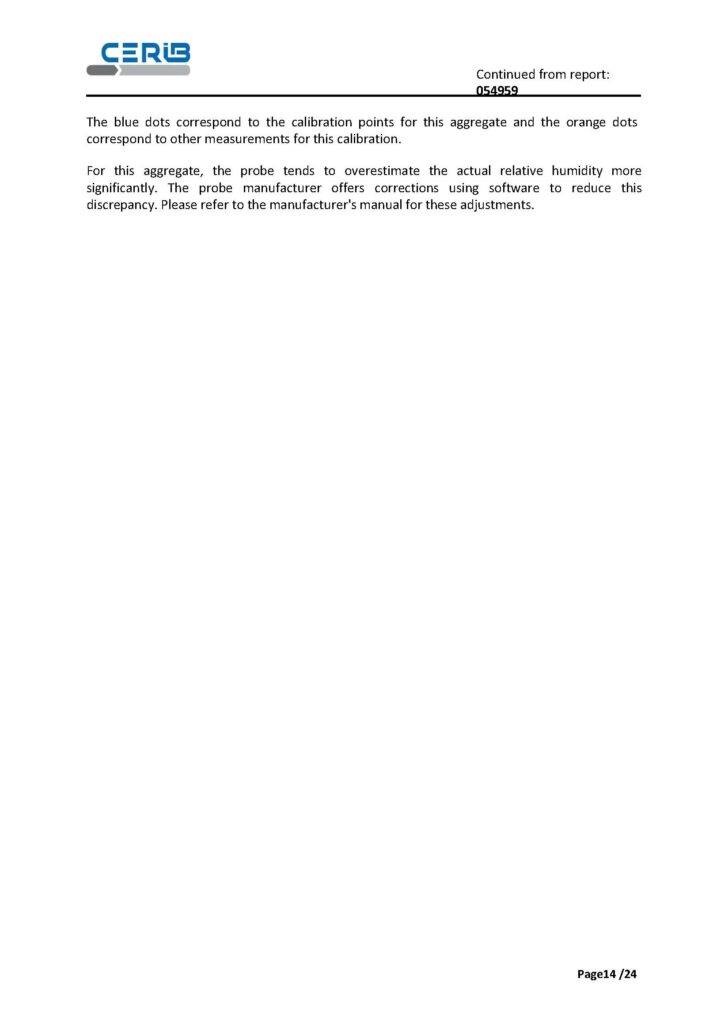
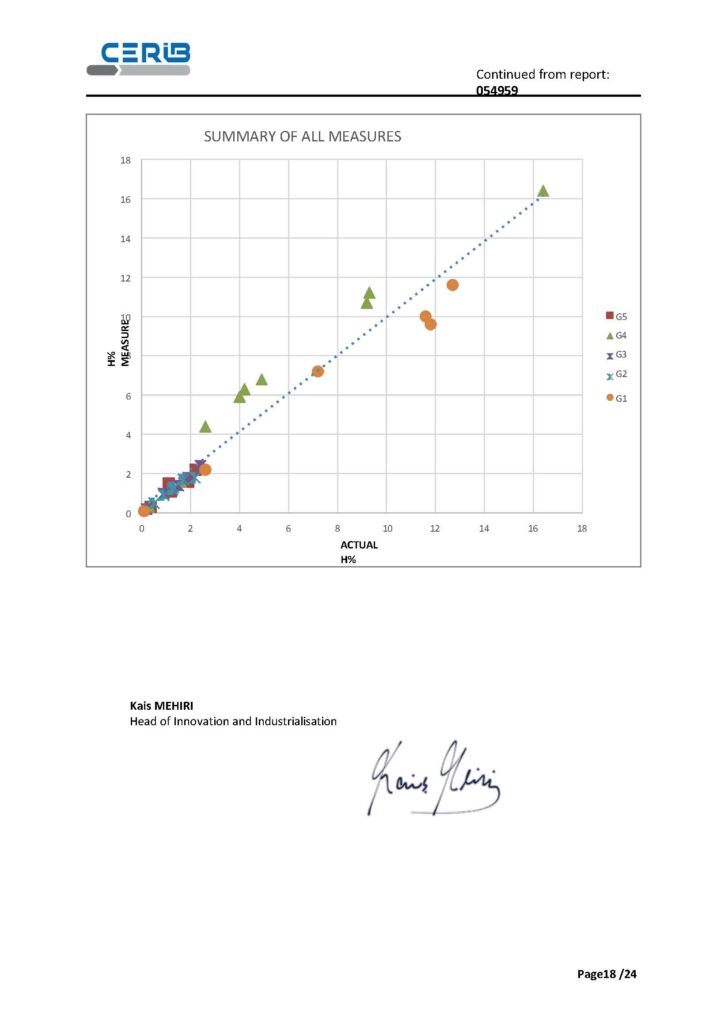
- G1: tendency to underestimate the ‘actual’ relative humidity by 9 to 19% depending on the measured value; software corrections are mentioned by the manufacturer to reduce the discrepancy.
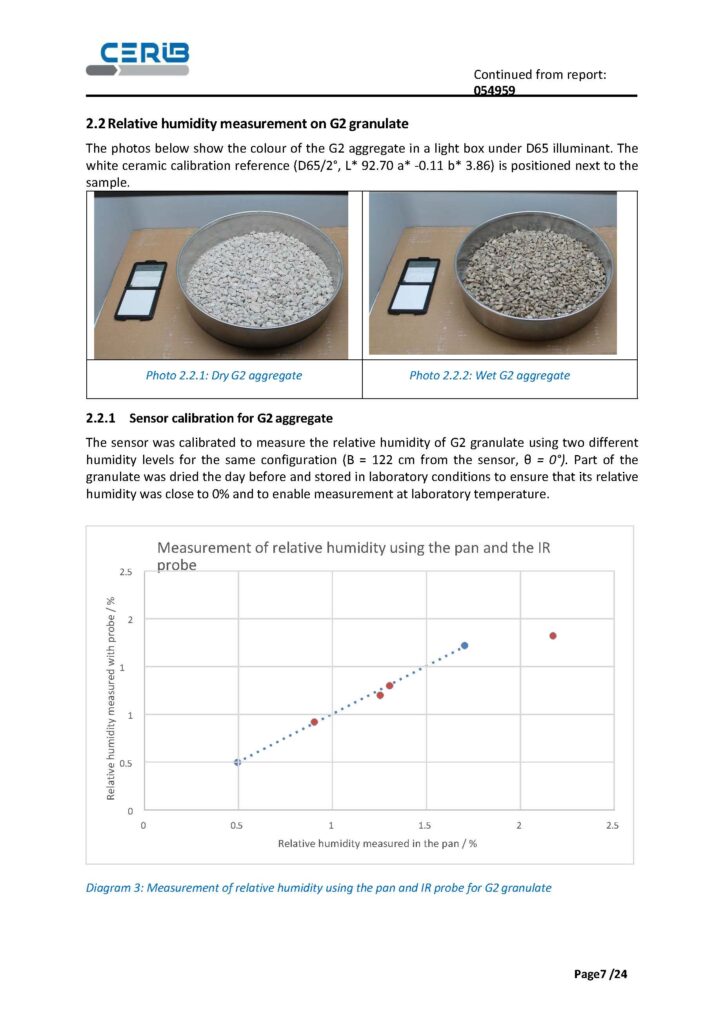
- G2 : tendency to underestimate by 0 to 17% depending on the measured value; software corrections also mentioned by the manufacturer.
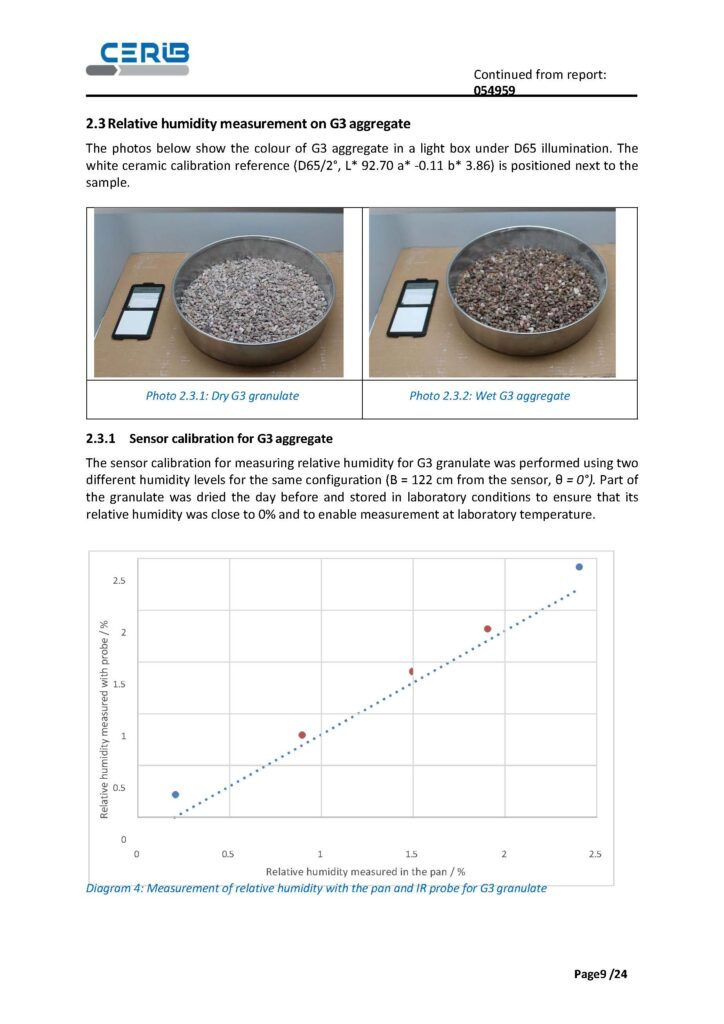
- G3 : tendency to underestimate by 5 to 11% depending on the measured value; software corrections mentioned.
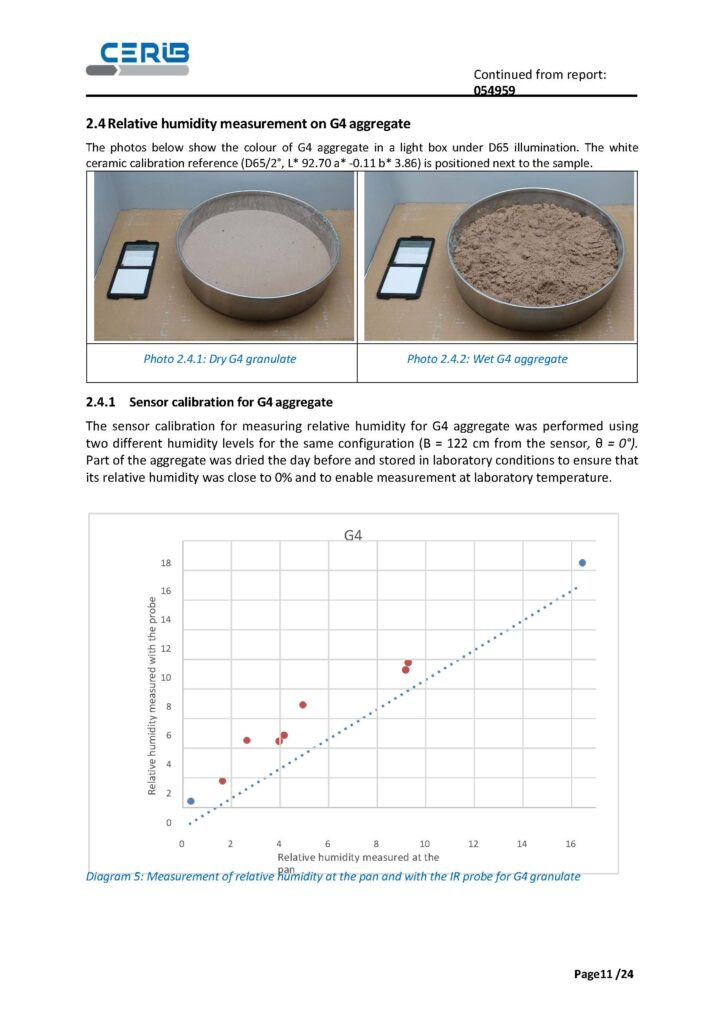
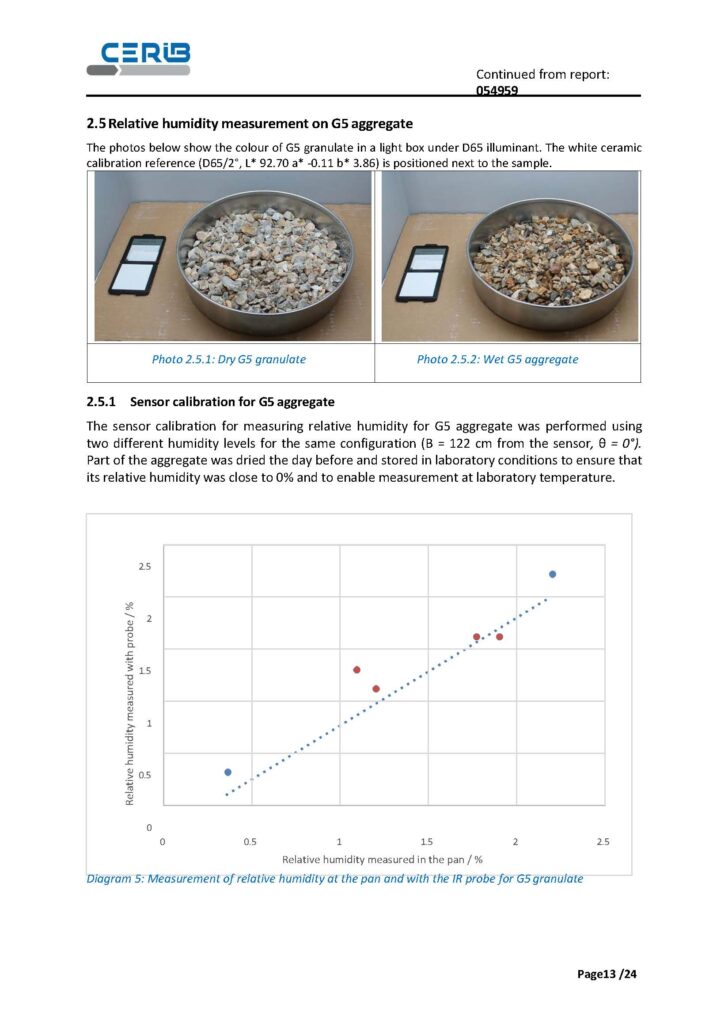
- G4 et G5 : tendency to overestimate more, with the same logic: corrections possible via software according to the manufacturer.
For all points, the report provides a graphical summary linking ‘actual’ humidity and measured humidity, which is useful for visualising the dispersion by granule.
Influencing factors: what the campaign highlights
Angle and distance: the two most influential parameters
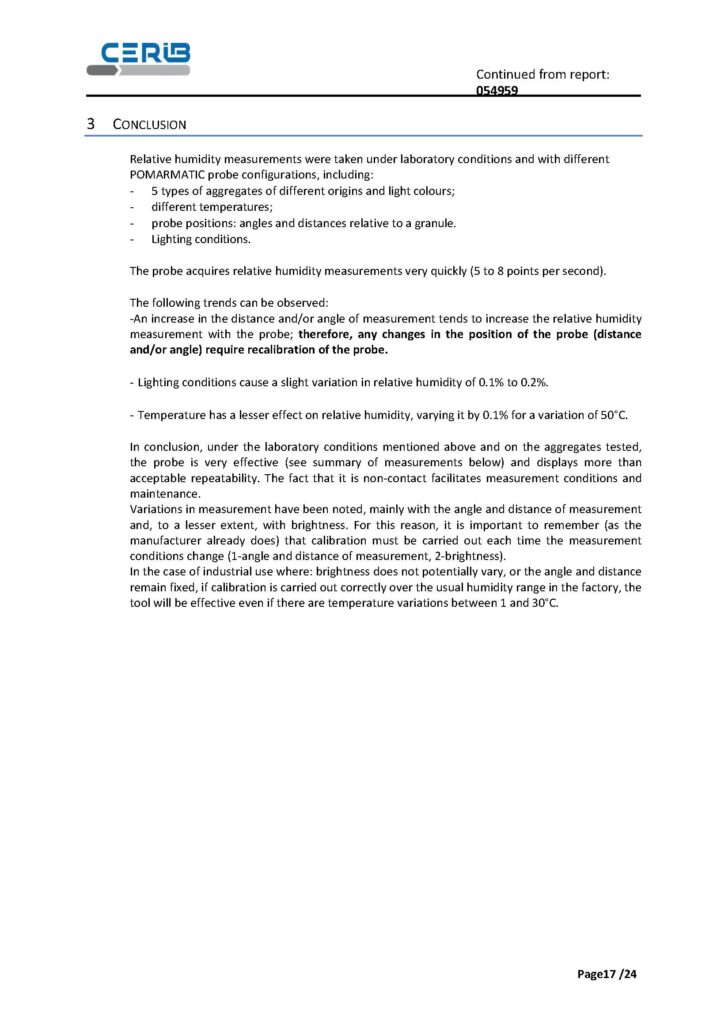
Campaign observes that an increase in distance and/or angle tends to increase the relative humidity measurement made by the probe; as a result, any change in position (angle/distance) requires recalibration.
Lighting conditions: measurable impact, to be framed
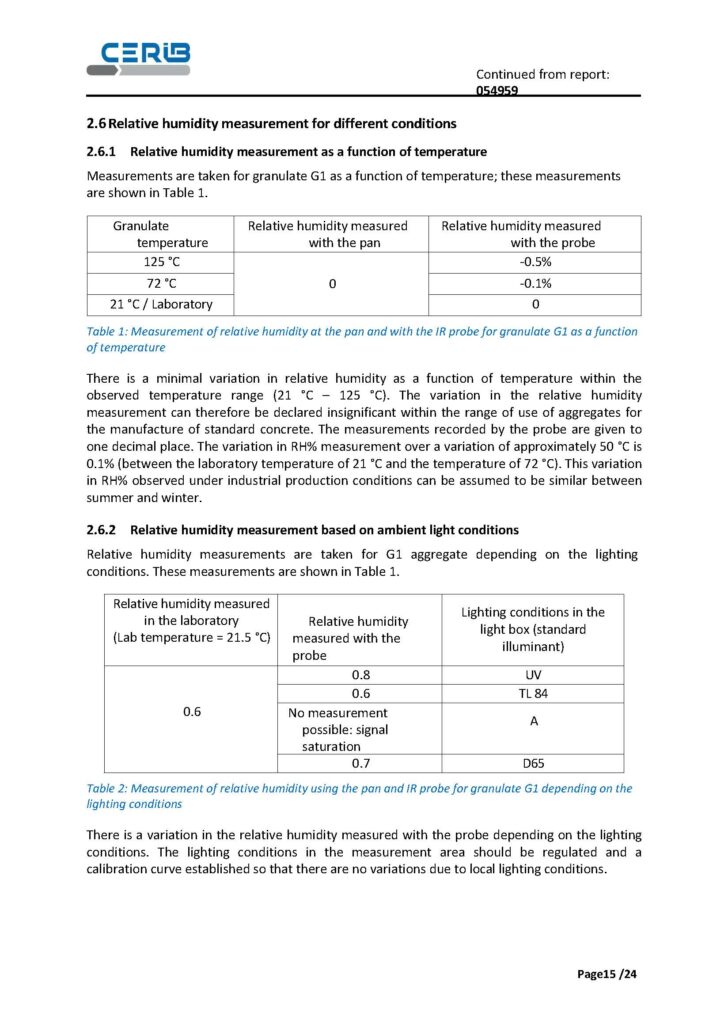
Measurements show a variation in the humidity measured depending on the lighting conditions (examples reported with UV, TL84, D65, and a case of saturation). The associated operational recommendation: regulate the lighting conditions in the measurement area and establish a calibration curve adapted to the context.
Temperature: effect deemed insignificant in the range tested
In the range observed (21°C to 125°C), the report notes a minimal variation: a variation of around 0.1% relative humidity for ~50°C, and qualifies this variation as insignificant for the intended use on aggregates in standard concrete.
Acquisition speed and repeatability: a highlighted strength
Report highlights very fast acquisition (in the order of 5 to 8 points per second) and concludes, under laboratory conditions and on the aggregates tested, that repeatability is considered ‘more than acceptable’. Non-contact aspect is presented as facilitating measurement and maintenance.
Industrial implications: conditions for success, without excessive promises
In an industrial setting where the angle and distance remain fixed and brightness remains stable, correct calibration over the usual range of humidity makes the tool effective, even with temperature variations between 1°C and 30°C.
Key point emerging from the characterisation: performance depends heavily on control of measurement conditions and calibration discipline (particularly after any change in angle/distance, and in the event of variations in brightness).
Source citation and publication precautions
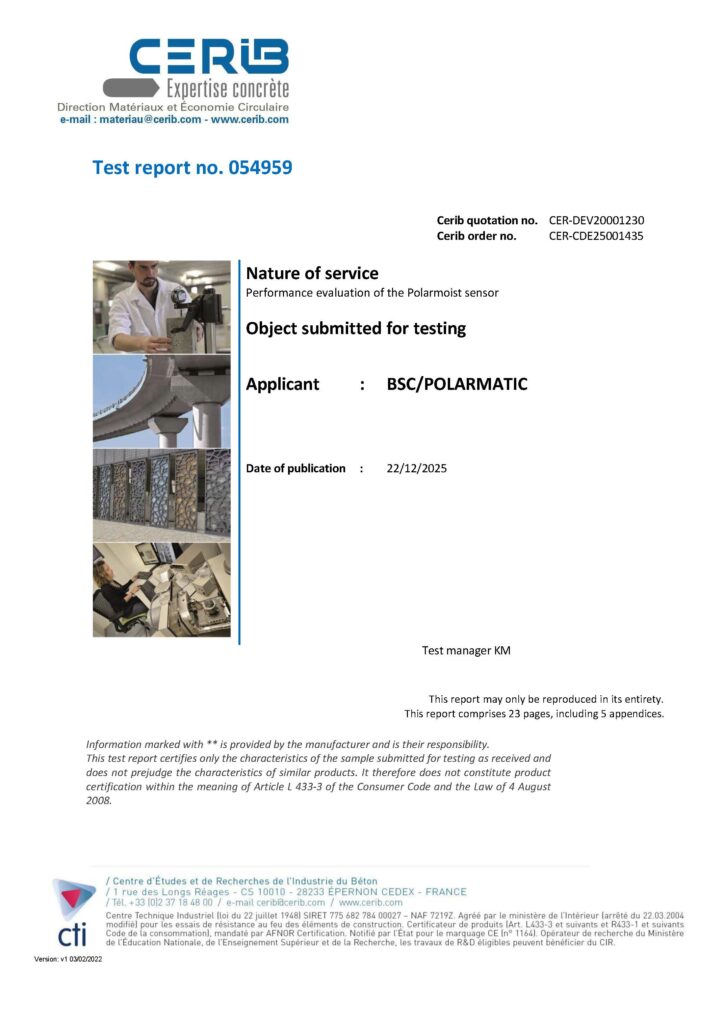
Summary is based on CERIB test report no. 054959, published on 22/12/2025. The report states that its results relate to the sample received and tested, and that the document does not constitute product certification; reproduction of the report is authorised only in its entirety.